

Roaring Lions: How the War in Iran Advances Israel’s Grand Strategy

A photo captured by the Israeli Defense Forces of a soldier with his arms outstretched to the sun
The war in Iran did not begin on February 28th; the Israeli government has been nurturing this confrontation for decades. Prime Minister Benjamin Netanyahu has been in front of the US congress, ringing the alarm about a nuclear Iran, for the last three decades. He tried to force President Obama into a war with Iran numerous times—in the words of former Secretary of State Antony Blinken, “the Israelis were pushing President Obama to take military action against Iran and were warning that they would do it themselves if he didn’t.” When that didn’t work, Netanyahu tried to kill the Iran nuclear deal, warning Congress members that Iran is a “threat to the entire world” ahead of the 2015 agreement. During the Biden administration, Netanyahu tried to push President Biden into a shooting war with Iran in April 2024, but Biden firmly resisted. President Trump finally took the bait, first with the 12 day war and now with Operation Epic Fury. For observers asking the question of “why now,” this is the principal reason: Prime Minister Netanyahu finally found a US President willing to back Israel in a war against Iran, providing them the capability to pursue the operation. As Netanyahu put it on March 1st, “The assistance of the United States…allows us to do what I have yearned to do for 40 years: smite the terror regime hip and thigh.” The Israeli government has spent decades lobbying for this war because it can help them achieve two related goals that they believe are crucial to Israel’s security and national identity: regional dominance and territorial expansion.
The Israeli government’s public-facing justification for this war concerns Iran’s nuclear and ballistic missile program. It is true that these Iranian capabilities pose a threat to Israel—Iranian ballistic missiles can reach Israel within ten minutes. However, it is unlikely that Iran and its weapons programs posed an imminent threat to Israeli security. Iran’s nuclear program was significantly damaged in the 12-day war.Furthermore, an Omani foreign minister and key player in US-Iran talks reported that a “peace deal is within reach” just two days before the war, with the Iranians apparently conceding to “zero accumulation, zero stockpiling [of enriched uranium], and full verification,” which would cripple their nuclear program. Nevertheless, the US and Israel launched attacks before scheduled negotiations were even complete. This war is not in response to an imminent threat. It is a war of opportunity aimed at achieving long term strategic objectives.
First, Israel aims to eliminate its regional competitors in the Middle East and dominate the region. The strategic logic is clear: in the anarchic world of international politics, where there are no policemen to come to a nation’s rescue, states feel incredible pressure to accumulate sufficient power to protect themselves against other players in the system. The surest way for a nation-state to protect itself in the international system is to become the indisputably dominant power in its neighborhood. Israel feels this pressure perhaps more intensely than any other nation-state. It has been surrounded by hostile actors since its founding, with five Arab nations launching a war against the nascent Israeli state a day after its founding in 1948. It is no wonder that Israel believes it needs unquestionable dominance to ensure its security in the Middle East.
Second, Israel pursues territorial expansion for both strategic and religious reasons. Strategically, territorial expansion complements a nation's strength and dominance. Through territorial expansion, Israel can seize strategic resources, enhance its power projection capabilities, and create space for a larger population, serving its first goal of regional hegemony. Israel has pursued strategic territorial expansion numerous times in the past; for instance, it captured the Golan Heights in 1967 to project power in Syria and dominate water resources. Indeed, territorial expansion lies at the very heart of Israeli strategic thinking—in 1919, the World Zionist Organization (WZO) submitted a resolution to the Paris Peace Conference demanding national boundaries roughly twice as large as the current Israeli state (counting occupied territories as “Israeli”). They argued that access to this large swath of land is "essential for the necessary economic foundations of the country."Given that the WZO consolidated the Zionist movement and fathered the state of Israel, their statements make it clear that territorial expansion is central to Israeli strategic logic. However, strategic thinking alone does not explain Israel's expansionary desires.
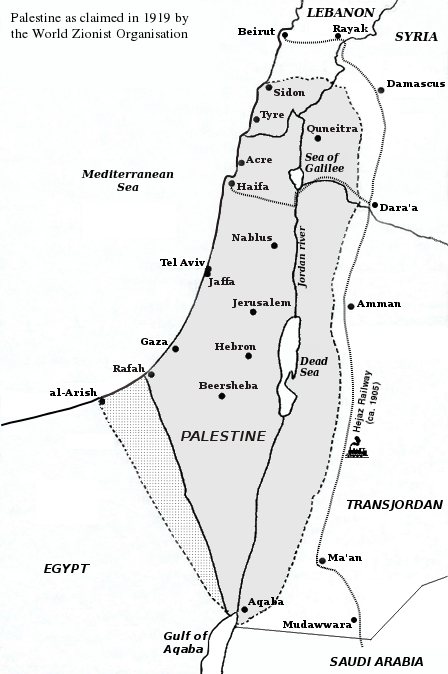
Map of the WZO’s 1919 territorial claims
Religious beliefs about Israel's national boundaries are foundational to the country's national identity and play an outsized role in the current government's far-right politics. In the WZO's words, "Palestine...is the historic home of the Jews...By violence they were driven from Palestine, and...they have never ceased to cherish the longing and the hope of a return." The land where Israel lies has always carried deep, ontological significance for the nation, yet it has seldom been clearly defined, with its lines moving with persistent force over time. After all, if we were to follow the Old Testament’s interpretation of the border question, Israel would stretch from the Nile River to the Euphrates River, which encompasses most of the Middle East. While open advocacy for this degree of expansion is not mainstream, it has found champions among far-right politicians, including sitting members of the government. Finance minister Bezalel Smotrich declared that Israel is destined to"expand to Damascus", and former mayor Daniella Weiss claimed,"the real borders of Greater Israel are the Euphrates and the Nile." The Overton Window for expansionary politics will continue to shift right during wartime, with a recent poll finding that 75% of new voters in Israel identify as right-wing. It is difficult to estimate the exact territorial ambitions of the current Israeli leadership; it is even more difficult to ascertain the ambitions of future Israeli leadership. What we do know is that Israeli political society is undergoing a rightward shift effected by a potent cocktail: hard-nosed wartime strategy mixed with fervent religious nationalism. Under such influences, the Israeli government may attempt to annex as much land as possible, especially when opportune, as it so often is during war.

Borders of Greater Israel per the maximalist Old Testament interpretation
In order to accomplish their goals of regional dominance and territorial expansion, the Israeli government pursued a war with Iran. It is clear how war with Iran serves Israel's first objective. Iran is Israel's foremost regional competitor, especially because of its critical support for anti-Israel militant groups in the region, including Hezbollah in Lebanon. It follows that without the Iranian government and its proxies, Israel's relative power in the region would surge. Of course, this would also serve Israel's second objective of territorial expansion. The primary mechanism through which this war serves Israeli expansion, however, is conflict itself.
War-fighting accelerates Israel's bid for territorial acquisition by providing the country a necessary pretext for expansion. The war has already enabled an Israeli ground invasion of Southern Lebanon, which Defense Minister Israel Katz has said will translate to long-term territorial expansion. Conveniently, Lebanon falls within the realm of Greater Israel. War is the gift that keeps on giving, at least with regard to territorial expansion. There is no better time to quickly move lines on the map and take land by force than during conflict; Israel understands this perfectly well, with the nation quadrupling in size thanks to the 1967 Arab-Israeli war. In that sense, a war in Iran could prove to be a strategic wellspring for Israel.

Israeli troops rolling into Rafah in June, 1967
Indeed, the war has already fostered conditions where peace and normal relations with Iran are no longer possible for Israel’s allies. In less than a year, Iran has been hit by US-Israeli attacks during ongoing negotiations. If Iran was willing to negotiate away their nuclear weapons program before this war, they will almost certainly not agree to do so now. A popular adage that starts with “fool me once” comes to mind—any degree of trust or aligned incentives for peace between Iran and US/Israel have been struck down irretrievably. This is exacerbated by the fact that the Israeli-American strategy of killing Iranian leadership has only made the regime more hawkish. The war has only elevated hardline leaders like Mojtaba Khamenei and Mohammad Bagher Zolghadr, and solidified the Islamic Revolutionary Guard Corps (IRGC)’s power in the nation. In this sense, Trump’s claim that “we have regime change” in Iran “because the leaders are all very different from the ones that we started off with” is absolutely true. If the Trump administration found the old Iranian regime intransigent, they are in for a rude awakening with the new one, which has every reason to believe that peace or compromise with the US and Israel is impossible.
The relevant actors involved in this war are aware of these realities. This is why Saudi Arabia is pressuring the US to continue and escalate the war, with Crown Prince Mohammad bin Salman pushing Trump towards a total destruction of the Iranian regime. Saudi Arabia understands that this is the only path forward—in the words of former Saudi minister of state Khalid Al Jabri, “a partially degraded Iran, a wounded lion, would be more unpredictable and more dangerous. The policy was, don’t start the war, but if you start it, finish the job.” A more “unpredictable and dangerous” Iran is an existential threat to a country like Saudi Arabia, which relies on desalination plants that Iran has threatened for drinking water. It is important to remember that Saudi Arabia and Iran announced that they would normalize diplomatic relations just three years ago; by escalating hostilities, Israel has transformed this nascent diplomacy to bitter enmity, serving their regional ambitions by playing Saudi Arabia against Iran.
Even after the regime falls, Iran may remain a useful enemy for Israel. In my previous article, I argued that an Iranian state destroyed by war would fall into warlordism and insurgency, similar to post-Ba'athist Iraq. The Israeli government could leverage such Iranian instability as a pretext for further war and conquest. Indeed, Israel has pursued this strategy for years. The Israeli government provided tremendous support to Hamas since its inception in order to weaken the Palestinian Liberation Organization (PLO), which was secular and internationally recognized. After all, it is much easier to justify combat against a radical Islamist than a secular liberationist. As Prime Minister Netanyahu put it in 2019, “Anyone who wants to prevent the establishment of a Palestinian state needs to support strengthening Hamas.” The same strategy has been employed against Iran, which is widely perceived in the West as a radical and irrational state. Based on the empirical record and the trajectory of this conflict, the Israeli state can use this war to birth more useful enemies to justify expansion.
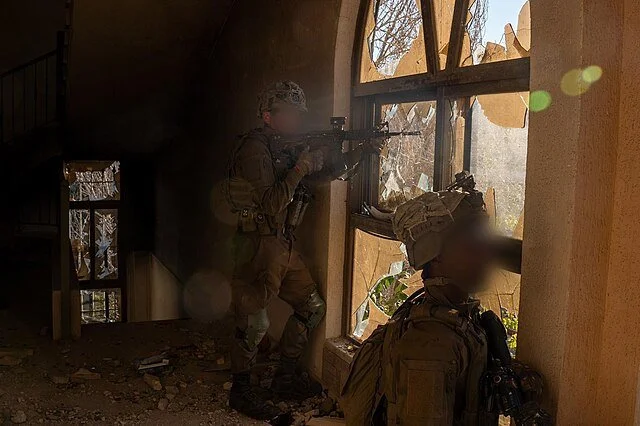
Israeli troops in Southern Lebanon during Operation Roaring Lions
Israel has been rallying for war with Iran since at least the 1990s. They started the 12-day war against Iran despite ongoing negotiations, and they started the current war under very similar conditions. It is highly unlikely that Iran and its nuclear weapons program posed any imminent threat to Israel as Prime Minister Netanyahu’s government may claim. Netanyahu himself has insisted that Iran is on the brink of acquiring a nuclear weapon since 1992. His prophecy has never come to fruition, and it is doubtful that he was any closer to the truth this year, especially since Iran’s nuclear facilities were severely depleted last June. In other words, this war was not inevitable or unavoidable—the Israeli government chose to fight in order to advance their ambitions of regional dominance and territorial expansion. Since February 28, Israel has already invaded Lebanon and won official Saudi support for escalation and regime change in Iran. However, the Israeli government is playing with fire. This war severely threatens Israel’s homeland security, access to drinking water, and economic stability. It is costing Israel 3 billion dollars a week and exposes it to a hailstorm of missile fire, with recent Iranian strikes coming close to a nuclear facility. Furthermore, it is accelerating Israel’s fall from favor among Western publics and politicians; due to a rift over the war, Spain has recalled their ambassador from Israel. By barreling down the warpath, Israel is undermining its own security and isolating itself on the world stage. If the Israeli government truly desires safety and security for its people, it should be wary of hedging its bids for peace on declarations of war.
All images sourced from Wikimedia Commons under Creative Commons 4.0 License
