

A Lose-Lose Situation: Why an American Victory is Impossible in Iran
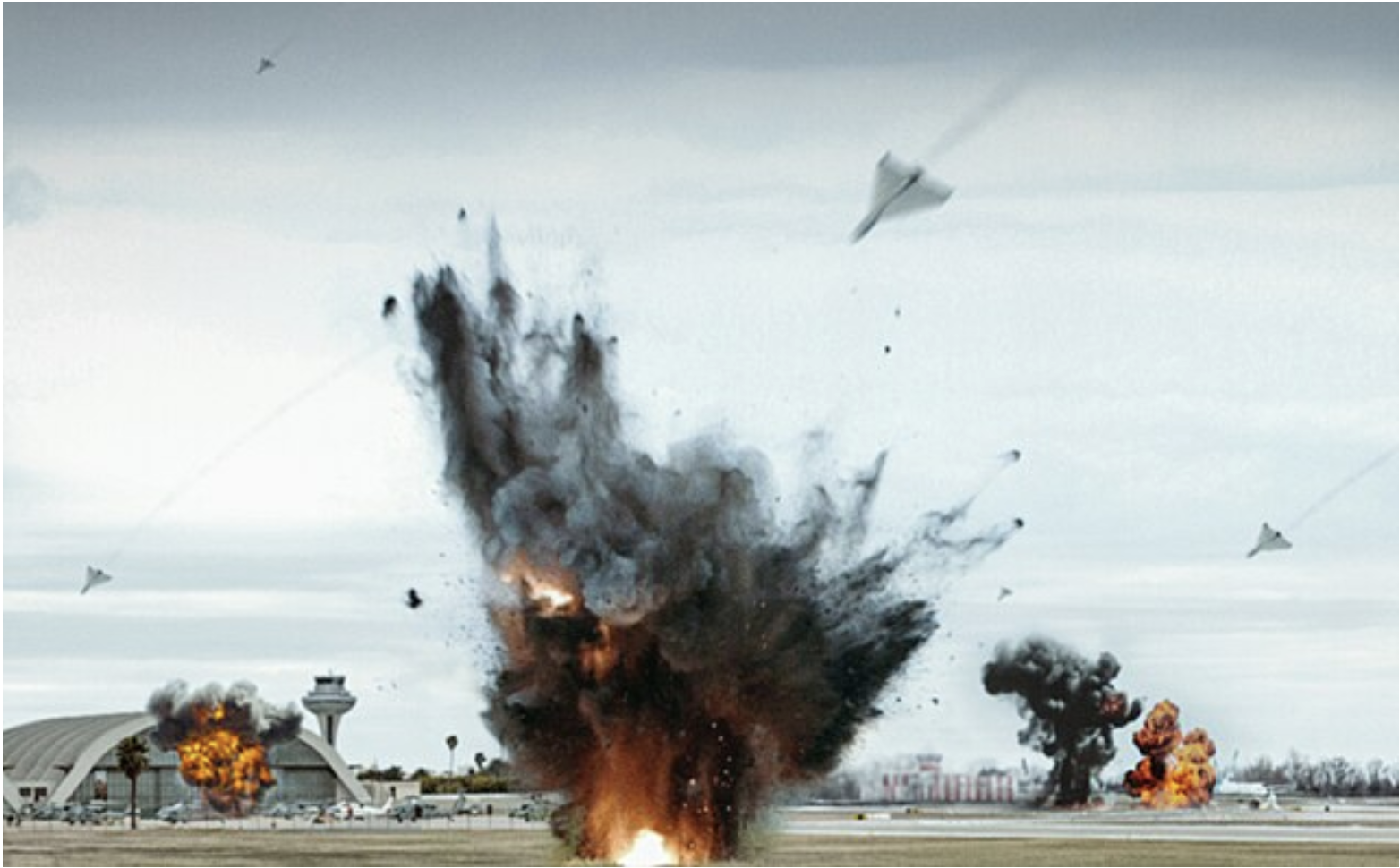
Rendition of Iran's Shahed-136 drones swarming an airport
As war continues to ravage the Middle East, analysts around the world are debating whether the United States and Israel will achieve their goal of toppling Iran’s government. As it stands, any hope for a speedy American victory is fading quickly, as the Iranian government stands resolute despite Ayatollah Khamenei's death. Furthermore, the empirical record suggests that even if the Iranian regime falls, the war would be to the US's detriment. We are looking at a lose-lose situation in Iran.
Firstly, it is highly unlikely that the US will overthrow the Iranian government during this conflict. The American strategy is rooted in an air campaign targeting Iran's economy, capital, and leadership, aiming to create the conditions for a popular revolution against the sitting regime. In anticipation of this strategy, Iran has adopted a decentralized command and control structure dubbed the “Mosaic Defense,” rendering leadership decapitation and strikes against Tehran ineffective. This is why the assassination of the Ayatollah and other top leaders have not disrupted Iranian military operations.
Not only is the US rapidly expending its military resources by embracing a largely ineffectual air strategy, but it is also undermining the organization of pro-West popular resistance against the regime. Though the US and Israel are targeting internal security forces that suppress dissent in Iran, it will be incredibly difficult for opposition groups to persuade Iranian publics that they should align themselves with the same forces that have been bombing them mercilessly. The historical record reveals that US military intervention in the Middle East, particularly in support of Israel, significantly heightens anti-American sentiment among Arab populations.

An Iranian military ceremony at the University of Imam Hossein
Some observers maintain that these incredible risks are worth the chance of removing the Iranian government. After all, Iran’s government is brutally authoritarian, with state media admitting that thousands were killed during protests last month. A Times of Israel writer recently wrote that “catastrophe may be avoided” if regime change is accomplished in Iran. An analyst from the Chicago Council on Global Affairs mused of a Washington-backed Iran’s neoliberal potential. It is dangerously naive, however, to assume that Iran will benefit from regime change. Given the US’s history of state-building in the Middle East, matters may become significantly worse for Iran.
Even if we assume that the US is able to destroy the Iranian regime in spite of its major obstacles, the aftermath may keep us in a protracted conflict. Many forget that the Bush administration toppled Saddam Hussein's regime and announced victory just 20 days after combat operations commenced in Iraq. However, the subsequent power vacuum and state failure in Iraq gave rise to infamous terror groups like ISIS, dragging the Iraq war on for another 8 years.

A defaced billboard of Saddam Hussein captured by Lance Corporal Matthew R. Jones
There is good reason to believe that we would face the same outcome in Iran. Similar to Iraq, Iran is an ethnically diverse country, with prominent minorities like the Kurds, Balochs, and Azeris living alongside the majority Persian population. The Iranian regime also supports numerous armed militias, including Hezbollah, Hamas, Houthis, and Iraq-based Special Groups, to name a few. If these far-reaching proxies lose their main source of funding and support, they may compete for power and control in an Iranian rump state rather than going quietly into the night.
If the US somehow destroyed Iran's highly complex governing structure, a gaping power vacuum would be left in its wake, with numerous ethnic and armed groups ready to vie for control. Vacuums yearn to close, and there is no dearth of ambitious actors ready to snatch power during a moment of state fragility. Ironically, even President Trump would agree — in 2016, he rallied against regime change wars, arguing that they create “power vacuums that are filled simply by terrorists.” For instance, after the Ba'athist government collapsed during the Iraq War, sectarian violence exploded, and groups like ISIS formed to fill the power vacuum. In Iraq, the US traded one enemy for a thousand more. We are at risk of doing the same in Iran.
Although the Iraq War has been routinely savaged by all ends of the political spectrum, the US government seems hellbent on making the same strategic mistakes. While Iran has learned from history and adapted to the American strategy, the US has not done the same due diligence. The US faces two outcomes at this moment: fail to impel regime change in Iran, or succeed and leave behind a fractured state rife with sectarian conflict. The ensuing fallout of “successful” regime change will keep the US in Iran, foment generations of anti-American sentiment, and likely prop up another militantly anti-Western regime. No matter which direction this war goes, an American victory is not one of the possible outcomes. American hubris has become the enemy of strategic thinking, triggering a cycle of perpetual warmongering. If future American administrations refuse to learn from history, this will not be our last war in the Middle East.
All images sourced from Wikimedia Commons under Creative Commons 4.0 License
